
Finding Albuquerque Resident Records
Begin with the fact that identifies the record, not a broad guess. An Albuquerque street address is strongest when it can be tied to a Bernalillo County parcel identifier, known as a PARID. A full name can be checked against a property card, a dated directory, or a court case number. An older address should be searched with its quadrant and, when needed, a former street name. A property listing identifies an owner of record, not every person at the site. A directory is dated evidence, not a precise move date. That distinction keeps an Albuquerque residents directory search useful and fair.
Use one result to form the next question. The Assessor can provide a parcel key and legal description. The County Clerk's recorder index can then locate recorded instruments. Special Collections can test whether the same name or address appears in a dated directory. For a current official record not online, ask the agency that actually holds it. The City Clerk routes City-held records, while County, court, and state material belongs with its own custodian.
- Start with the Bernalillo County Assessor Public Access card when an address or owner name is known, and save the PARID, tax year, situs address, and legal description.
- Use the PARID, document number, legal description, or surname in the Recorder Documents search to find an instrument trail.
- For a name with a court lead, screen it in New Mexico Case Lookup, then take the case number to the named court custodian for records.
- For a historical household, select a year and ask the Special Collections Library or UNM holdings for the relevant city-directory volume.
- When no public screen answers a defined records question, make an IPRA request that gives the address, department, date range, case number, or document number.
Note: Record the source date and identifier used, because public systems can update on different schedules.
Albuquerque Resident Records Offices
Albuquerque's current record trail is mainly a Bernalillo County and New Mexico system. The County Clerk keeps recorded instruments and county-clerk functions. The County Assessor supplies parcel-card context. The Secretary of State describes voter-data access and protections. Each office answers a narrower question than a general directory: a parcel card can show an owner and mailing line, a deed index records parties to an instrument, and voter data has a public and protected split. The address-by-address sequence is developed on the Albuquerque Street Directory page.
Bernalillo County Clerk
415 Silver Avenue SW, second floor
Albuquerque, NM 87102
505-468-1290
New Mexico Secretary of State
State voter-data information and protected-field rules
The City Clerk accepts City IPRA requests through its records portal, by mail, or in person. It asks for enough detail to identify an existing record series. That makes a department, address, date range, project, or permit number more practical than a request to identify a person from a vague description.
Albuquerque Parcel Cards by Name
The Assessor is the best first pass for an Albuquerque property connection. Its public card can show a PARID, selected tax year, current owner and mailing lines, location address, legal description, tax district, class, document number, building size, year built, lot size, land use, and style. The portal requires acceptance of a disclaimer and says assessment information may be incomplete, preliminary, or not current. Preserve that caution with any result.
A situs address is the parcel's physical location. A mailing line is where tax correspondence goes. They may match, but neither field alone proves that a person currently lives at the property. A legal description and PARID are more stable links when a street name changes, a number is reassigned, or a building has several units.
Use the Assessor Public Access portal as the starting screen shown here.
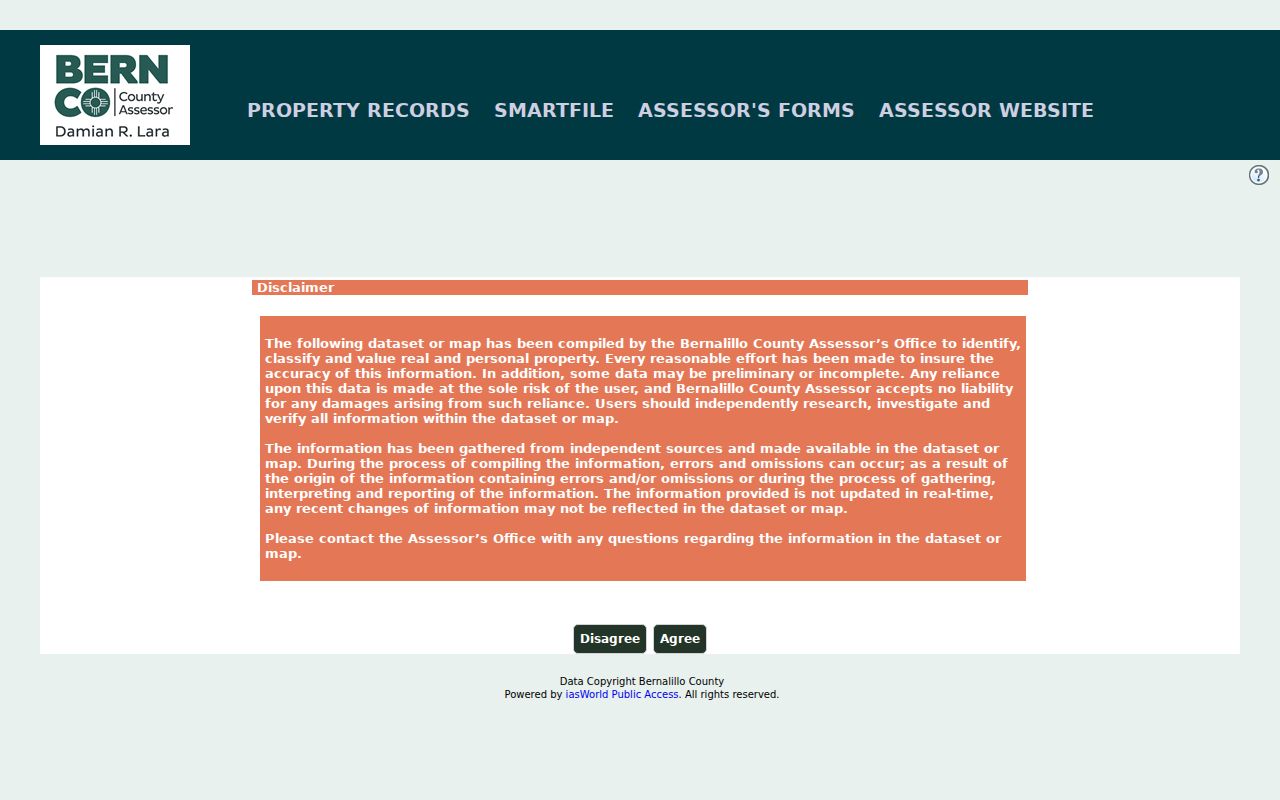
The parcel search is useful for capturing a stable record key before checking a separate recorded-document or historical source.
| Card field | How to use it |
|---|---|
| PARID | Stable parcel identifier for notes and related County searches. |
| Situs address | Physical parcel location, distinct from tax correspondence. |
| Legal description | Bridge to Recorder fields such as subdivision, lot, block, tract, or unit. |
| Document number | Possible direct link to a recorded instrument. |
Albuquerque Recorder Name Trails
The Bernalillo County Clerk's Recorder Documents service is the instrument index for deeds, mortgages, liens, plats, releases, and related recorded material. Its page states that certified recorder documents run from January 1, 1800 through July 6, 2026. The electronic index is still a public-service tool, not a certified statement of authenticity. Ask the Clerk about a certified copy when one is needed, and do not assume every old entry has a complete online image.
The search fields make a careful name trail possible. Start with the surname first, without punctuation, then narrow by grantor or grantee role, recording dates, document number, book and page, legal description, parcel number, and document type. The help says spaces act as an OR condition, a plus sign requires a term, and Legal Remarks supports wildcard guidance. A deed requires reading the document type and parties, since a lien, easement, plat, or release does not prove a transfer.
| Recorder field | Use in an Albuquerque search |
|---|---|
| Grantor / Grantee | Separate prior and receiving parties when an instrument is a transfer. |
| Recording dates | Narrow same-name results to a usable period. |
| Document number | Open a record identified on an Assessor card. |
| Legal fields | Match subdivision, lot, block, tract, or section-township-range. |
| Document type | Distinguish a deed from a lien, release, plat, or other filing. |
Index: a list that points to records rather than the record itself. Parcel: a defined piece of land with a County identifier. Criss-cross directory: an address-first section in some historical directory volumes. Roll: a dated official list or data set, each with its own rules and limits.
Current Albuquerque Resident Directories
No single public roll lists every Albuquerque household. The useful sources each record a different relationship: property ownership, a recorded instrument, voter registration data under state rules, a court case, a permit event, or a dated community and library record. A result should be described at that level. The Albuquerque Resident Lookup workflow explains how to test a name against two independent sources without treating one screen as identity proof.
| Current source | What it can support | Custodian | Access boundary |
|---|---|---|---|
| Assessor property card | Owner of record, parcel, situs, mailing, and tax-year context | Bernalillo County Assessor | Free portal after disclaimer; not real time |
| Recorder Documents | Parties, recorded date, type, and legal description | County Clerk | Public index; certification through custodian |
| Voter-data program | Public voter-file fields and procedures | NM Secretary of State | Protected fields and Safe at Home exclusions apply |
| ABQ-PLAN | Address-linked project or permit trail | City Planning | Not proof of present occupancy |
| Recognized-neighborhood listings | Civic area and public contact context | City Office of Neighborhood Coordination | Not a private membership list |
A commercial search category can be convenient but may be incomplete, stale, or unclear about its source. Official records are slower to combine, yet they show the custodian, date, and record type. For a personal, lawful question, use official entries as the facts to verify and preserve the source date.
Albuquerque Court Record Routes
New Mexico Case Lookup is the free screening route for appellate, district, magistrate, metropolitan, and municipal case information. It does not display documents. re:SearchNM is the separate document-access system, with registration and access levels. Save the case number, named court, filing date, category, and displayed status before asking the custodian for a docket or pages.
Metropolitan Court's Records Viewing Room is on the first floor at 401 Lomas Boulevard NW, with stated weekday hours of 7:30 a.m. to 5 p.m. The court names metrorecordscustodian@nmcourts.gov as a request path and reports records back to 1984. Its published charges include $0.50 per photocopy, $1 per electronic or computer transfer, an extra $0.50 per certified page, and $5 for a CD. For older or unavailable judicial records, use the court IPRA route. Sealed, expunged, juvenile, adoption, and other protected matters remain restricted.
Visit New Mexico Case Lookup to identify a case path.
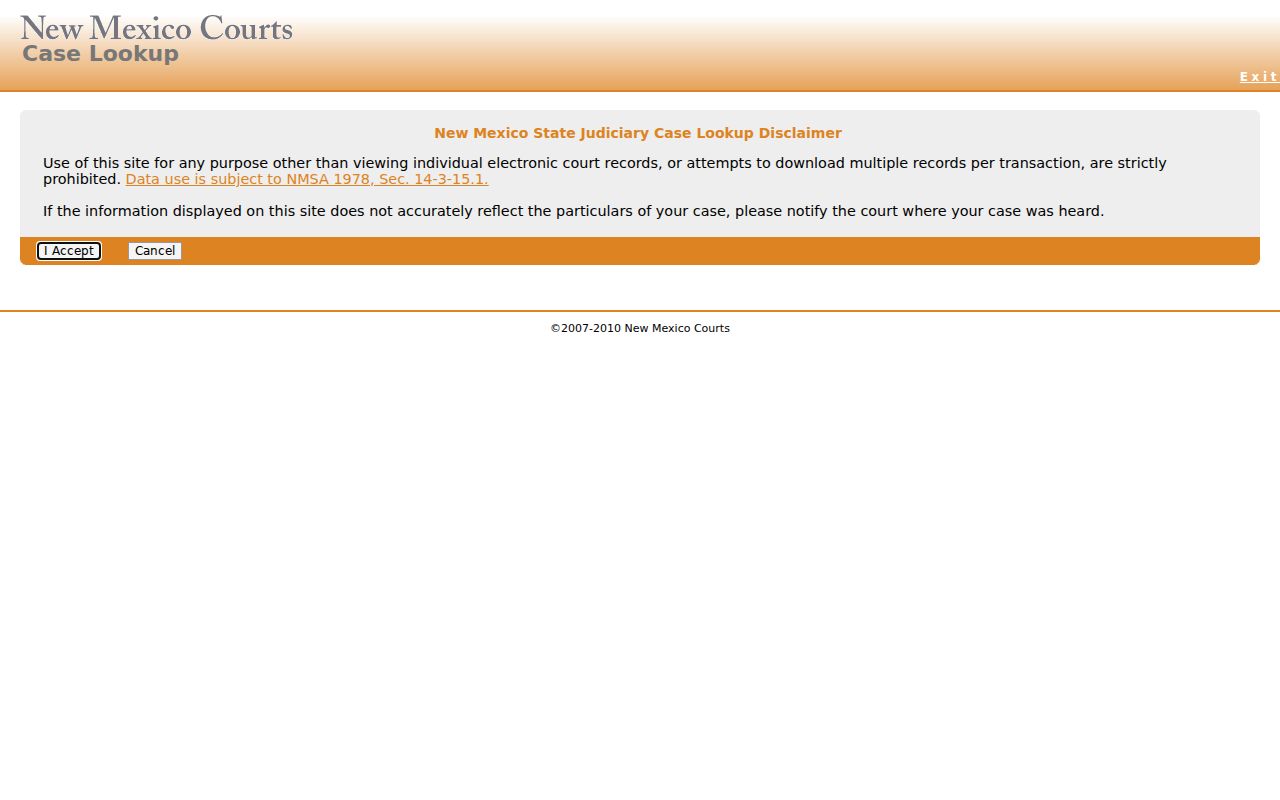
The public case screen is a way to locate the right court, not a substitute for the court's own document and privacy rules.
Albuquerque Maps and Permit Records
City AGIS is the municipal map layer for parcels, street address ranges, recognized neighborhoods, municipal boundaries, planning maps, and historical mapping resources. The City describes its parcel data as city lots with address and legal-description fields, and its streets layer as countywide. Map the place first, capture the parcel or legal description, then confirm it through the Assessor and Recorder. Exact interactive viewer filters were not established in the research, so use the map result as context rather than a final record.
ABQ-PLAN supports address, permit number, contractor, date, and project-name searches. Certificates of occupancy follow a separate OnBase route using the Building Safety search type and either street number, street name and quadrant, or a certificate or permit number. The City documents distinct development-case systems: Cognos from 1999 to 2008, Kiva from 2008 to 2018, POSSE/MESA from 2018 to 2025, and current ABQ-PLAN. A missing current search can reflect that system history.
Open the AGIS Maps for the Public hub before moving to the County record keyed by the map result.
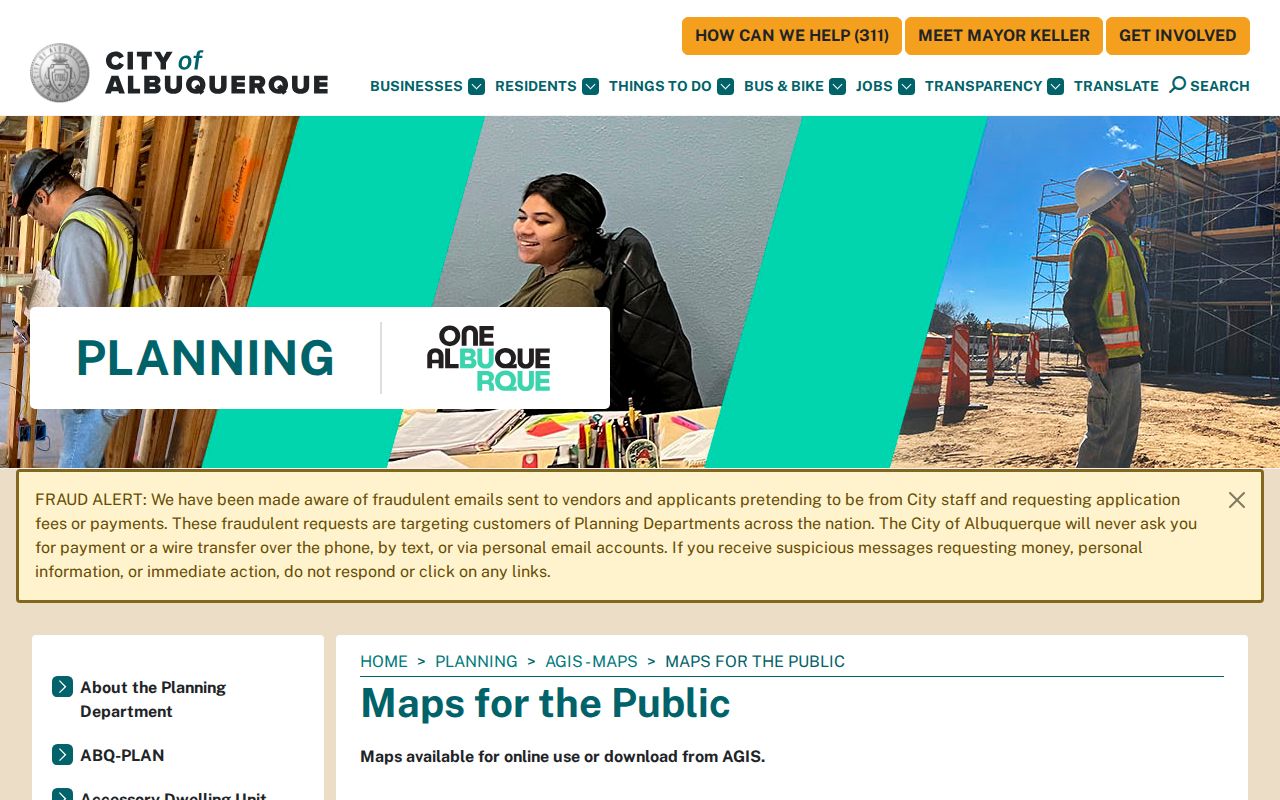
The map layer helps keep a street, quadrant, neighborhood, and municipal boundary in the same research note.
Note: A permit or planning entry records a project or event at an address, not a complete record of residents.
Albuquerque Voter Data Boundaries
New Mexico's SERVIS voter-file description includes voter name, address, consented phone number, birth year, party, county, precinct or district data, and voter history. Public voter information is separately described as full name, residence address, precinct number, registration date, party affiliation, voting history, and year of birth. Voter history reports participation, never ballot choices. The live Voter Portal fields were not safely inspected in this research, so do not invent a name-and-address lookup form from its title.
Social Security numbers, place of registration, day and month of birth, non-consented phones, and Safe at Home information are protected. Safe at Home is the Secretary of State's address-confidentiality program for qualifying safety circumstances. A blank or absent result can be a lawful protection, a migration issue, or a mismatch. Use the voter-data procedure or Bernalillo County Clerk for a specific lawful request instead of treating a nonmatch as a conclusion.
Albuquerque Vital Record Access
The New Mexico Department of Health Bureau of Vital Records and Health Statistics issues birth and death certificates. Birth records become public only 100 years after birth under the statutory conditions, and death records become public after 50 years. Otherwise, access is limited to the registrant, qualifying relatives, or a person with a tangible legal interest under NMSA 1978 §24-14-27 and 7.2.2 NMAC. County clerks issue marriage records; district courts retain divorce decrees.
Those separate custodians matter. A probate file can identify an estate process but is not a death certificate. A historical newspaper notice can add a date or relationship but should be confirmed in the record held by the proper office. For an older household, Special Collections and the State Archives offer different paths than NMDOH. Keep the record type, year, and access rule in the search note.
The New Mexico vital-records route shows the state custodian before an application is started.
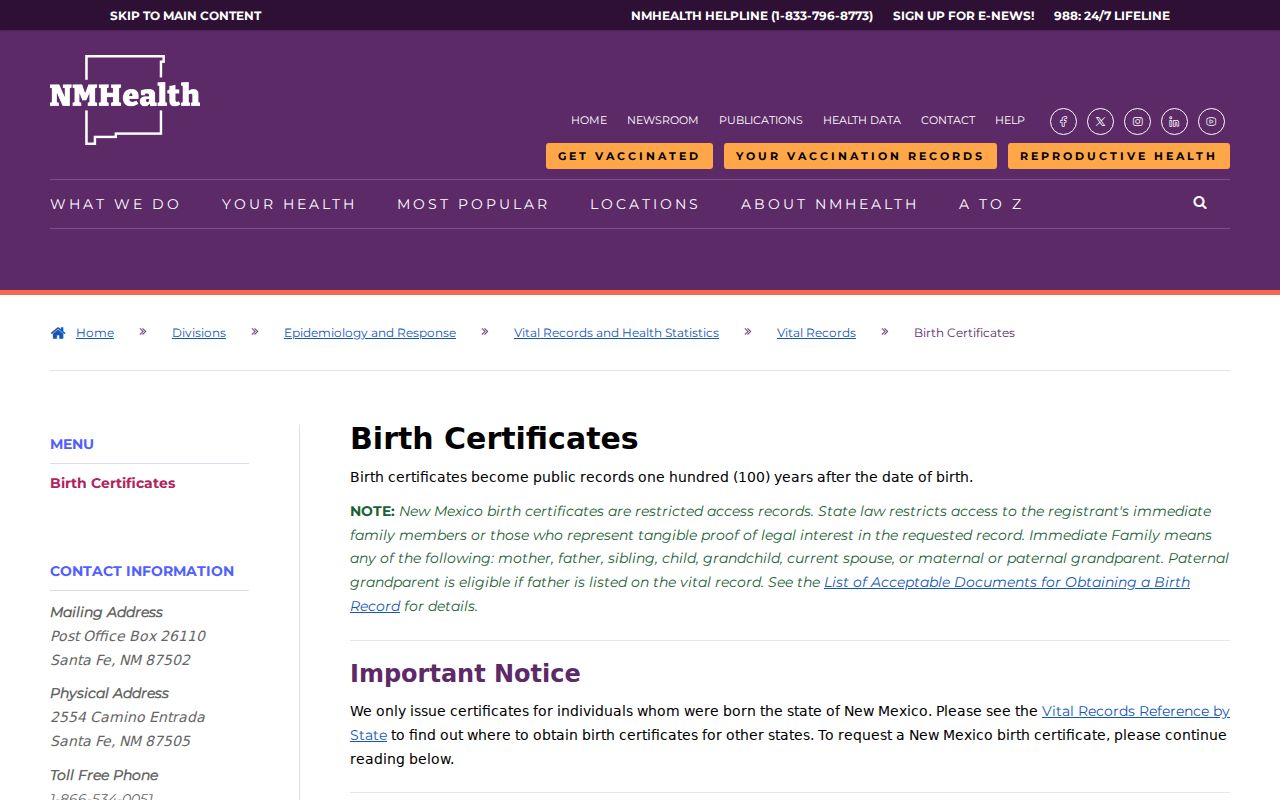
Vital-record applications require their own eligibility and identification review; a directory result does not change those rules.
Historical Albuquerque Resident Directories
Albuquerque-Bernalillo County Public Library Special Collections is the local historical shelf for city directories, telephone books, neighborhood plans, maps, photographs, newspapers, genealogy material, church records, family histories, and yearbooks. Its Genealogy Center is on the second floor of the Main Library. The Albuquerque Museum history-resources guide says City Directories from 1908 to the present are held by the Public Library at Fifth and Copper and by UNM's Center for Southwest Research and Zimmerman Library. The full collection method is kept on the Albuquerque City Directory page.
Earlier reference points are also real but need volume-level checking: McKenney's Albuquerque Business Directory in 1886, Albuquerque City and Business Directory in 1905 to 1906, Worley directories in 1913 to 1917, and Hudspeth directories beginning in 1919. Choose a year, inspect the actual volume's title page and abbreviation key, transcribe the entry, then compare nearby years and a property or archive source. A reverse section exists only where the target volume has one.
Albuquerque Directory Gaps and Dates
A 1935 Albuquerque Progress source reports 22,194 names in that year's City Directory while giving a local population of 44,388. The contrast is a useful warning: a city directory is a broad dated snapshot, not a census of everyone living in Albuquerque. A listed name can be good corroboration when paired with the same address in another dated record. An omitted name can reflect initials, a different household head, the publication cycle, or the volume's scope.
The 1890 federal population schedules were destroyed. The State Archives recommends bridging that loss with adjacent census years, directories, deeds, newspapers, tax and assessor records, and county or territorial materials. Its holdings identify federal census microfilm for 1850, 1860, 1870, 1880, 1885, 1900, 1910, and 1920, with indexes for selected years, alongside county records, court sources, land material, probate, and naturalization groups.
Albuquerque Street Names Through Time
Albuquerque street research has a local trap: the quadrant is part of the address. A missing NE, NW, SE, or SW can point to a different place. Historical names add another layer. Railroad Avenue became Central Avenue in 1907, and Lomas was formerly New York Avenue. Search both forms when the date crosses a rename, and retain the address number, quadrant, old name, source page, PARID, and legal description in the research log.
The railroad arrived in 1880, the town incorporated in 1885, the City reorganized in 1891, and the older settlement and several valley neighborhoods were annexed in 1949. That history explains why a historic record may sit in territorial, village, town, City, County, or later-annexation sources. It does not justify joining two similar names without a date and independent anchor.
Albuquerque IPRA Requests and Safety
New Mexico's Inspection of Public Records Act, NMSA 1978 §§14-2-1 through 14-2-12, is a way to request existing records from the custodian that holds them. A written request should identify the requester by name, mailing address, and telephone number and describe the records with reasonable particularity. The Attorney General's guidance says inspection is immediate or as soon as practicable and no later than 15 calendar days; when a record is unavailable within three business days, the agency must explain why and state an expected availability date. A denial must be in writing within 15 days.
IPRA does not require an agency to create a list or solve a research question. Ask for a defined record series and retain the response. If a notice suggests a deed, court, tax, or payment problem, verify it through the published custodian contact rather than an unsolicited caller. The City Office of Consumer Protection handles local scam and fraud complaints through its complaint route and 311. A source that fails to confirm a claim is a reason to check the next custodian, not to fill the gap with assumption.
Note: Use personal information only for a lawful purpose and stop when an access restriction or safety protection applies.